Add the legs, read the cut
Free Parlay Calculator: Payout, True Odds and What Legs Cost
A free parlay calculator that prints the payout next to the price of that payout, so the cost of adding a leg is visible before you add it.
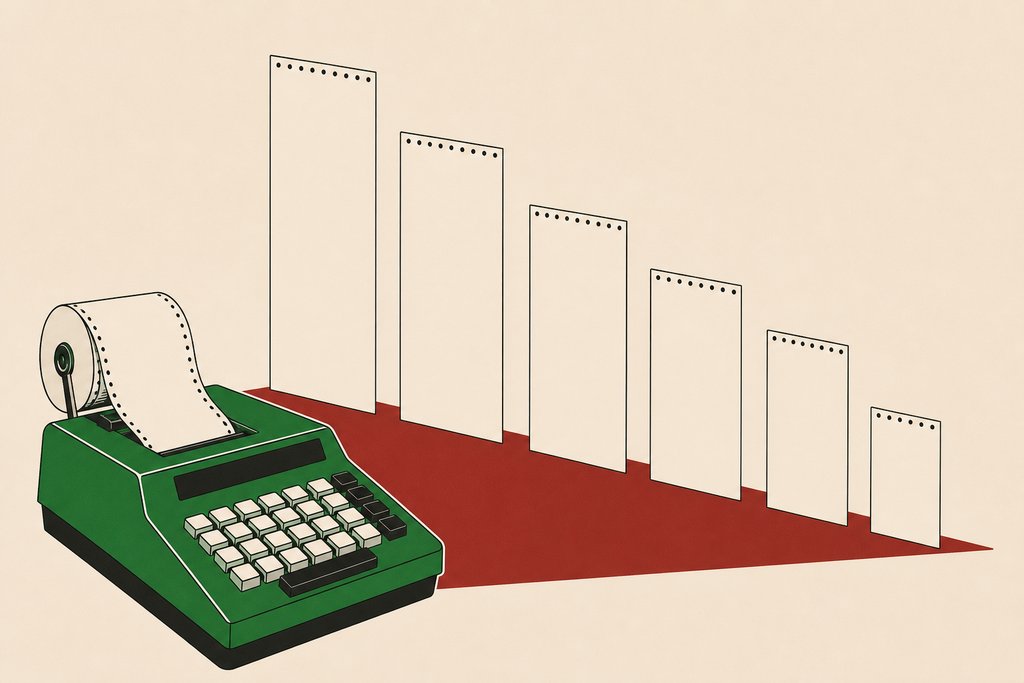
A free parlay calculator that shows the payout and the cut
A parlay is a bet that every one of several things happens. The payout multiplies, which is the attraction, and the margin multiplies with it, which is the part nobody advertises. On a single bet at −110 the book keeps 4.55 cents of every dollar staked. Put three of those bets on one ticket and it keeps 13.03 cents. Put eight on and it keeps 31.08. The parlay odds chart runs the same figures out to twelve.
Nothing about the slip changes to tell you that. The offered price goes up, the payout figure gets larger, and the cost buried inside it roughly triples between one leg and three. This parlay payout calculator prints both numbers so the trade is legible: what you stand to win, and what you are paying for the chance.
That is the whole design. A free parlay calculator is easy to find and most of them stop at the payout, because the payout is the number people came for. Knowing how to calculate parlay odds gets you that figure in about ten seconds. Knowing what the figure costs takes one more step, and it is the step that changes how a four-leg ticket looks next to a two-leg one.
How to calculate parlay odds without a calculator
Here is how to calculate parlay odds with nothing but arithmetic. Convert each leg to decimal odds and multiply. Decimal odds include the stake, so the product is the total return per unit staked; the profit is what remains once the stake comes out. Three legs at −110 are 1.909091 each. Multiplied, that is 6.957926, so a $100 ticket returns $695.79 and wins $595.79. Converted back to American, the price posts as +595.
Now do it again with the margin removed. In a two-way market where both sides are −110, the fair probability of each leg is 50%, so the fair decimal price is 2.00. Three of those multiply to 8.00, which is +700 and a $800 return on $100. The gap between $695.79 and $800 is $104.21, and that is the cost of the margin on this ticket rather than an estimate of it.
Expressed as a share, the book retains 13.03% of the fair payout. The formula behind that figure is short enough to check: retained equals one plus the market margin, raised to the power of minus the number of legs. At a margin of 4.7619% and three legs, that is 86.97%, so the cut is 13.03%. Each leg compounds against you, which is why the number climbs far faster than most people expect.
Where the arithmetic stops working
Two limits are worth stating plainly, because they are the difference between a useful number and a misleading one.
The first is correlation. Everything above assumes the legs are independent, so their probabilities multiply. A same-game parlay violates that assumption by construction: a quarterback throwing for four hundred yards and his team scoring thirty points are not independent events. Books price same-game tickets through a correlation model, and not by multiplying prices, which is why those tickets pay less than this arithmetic implies. Use this tool for legs spread across different games and treat a same-game quote as its own price.
The second is that a margin figure is not a forecast. A 13.03% cut does not mean you lose 13.03% of a given ticket. Any parlay wins in full or loses in full, and the variance on a long parlay is enormous. The cut describes the expected share of turnover the book retains across many such tickets, which is why it is the right number for comparing prices and the wrong number for predicting a Sunday.
One practical consequence does follow from it. Because the margin compounds per leg, the price of each leg matters more on a parlay than on a straight bet. Legs taken from tightly priced markets compound a smaller number; legs taken from wide markets compound a larger one. Change the prices in the calculator and watch the cost move while the leg count stays the same, and the effect is immediate.
It is worth running the parlay calculator against the ticket you were going to place anyway instead of a hypothetical one. Most people are struck less by the headline percentage than by the dollar figure beside it: on a $100 six-leg ticket the margin is over fifteen hundred dollars of foregone fair payout, which is a different sentence from “the book holds 24%” even though it states the same fact. A parlay payout calculator that reports only the return has no way of saying either one.
Two habits make this more useful than a payout figure on its own. Price the same legs as separate straight bets and compare the two costs, because that is the real decision rather than parlay-or-nothing. Then drop the weakest leg and recalculate: the cut falls faster than the payout does, and seeing by how much is the quickest way to judge whether that leg earned its place. Neither habit needs a view on the games, which is the point of a parlay calculator that prices the ticket instead of selling it.
Questions about parlay pricing
5 questions
01 How do I calculate parlay odds by hand?
Convert every leg to decimal odds, multiply them together, then convert the product back to American. Three legs at −110 are 1.909091 each; multiplied that is 6.957926, which posts as +595. The arithmetic is the easy part, and it is the same on every sportsbook.
02 Why is the offered price lower than the fair price?
Because each leg carries the market margin, and multiplying the legs multiplies the margin with them. Three fair coin flips would pay +700. Three legs priced at −110 pay +595. The book keeps the difference, which is 13.03% of the fair payout rather than the 4.55% it keeps on a single bet.
03 Does this parlay payout calculator work for same-game parlays?
Not reliably, and the reason is not the arithmetic. Same-game legs describe one event and move together, so they are correlated. Books price that correlation in directly instead of multiplying the individual prices, which is why a same-game ticket usually pays less than this calculator suggests. Use it for legs across different games.
04 Do longer odds make a parlay better value?
They change the payout, not the direction of the margin. What drives the cut is the number of legs and the margin on each one, so a four-leg parlay of tightly priced markets can cost less than a three-leg parlay of wide ones. Change the prices above and the cost figure moves with them.
05 What happens if one leg pushes?
Most American books drop a pushed leg and settle the parlay at the remaining legs, so a four-leg parlay with one push pays as a three-leg parlay. A void leg usually behaves the same way. House rules differ on this point more than on almost anything else, so it is worth reading them before the ticket matters.